



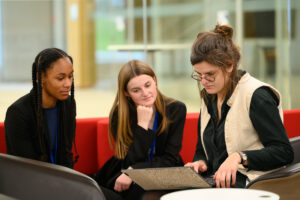
Three days at the ILO to observe FerMUN from the inside: hundreds of high school students, debates, negotiations, and a newsroom full of young journalists. A story of immersion at the heart of a conference where students are in charge.
Silence. Or rather, the feeling that I should remain silent. That’s the first thing I sense at the ILO, once I’ve passed the security checkpoint. A small moment of pride as I greet the guard and place my badge on the scanner for the first time. Then comes the sensation of feeling so… small in such an immense space. I hear students talking in the distance. There are more of them than adults around me. So many young people in a place usually reserved for those I consider specialists. Impressive. Very quickly, a familiar face appears. Ruben Buchot joins me. He will be my contact for the next three days, the press coordinator within the FerMUN 2026 board. He proudly wears his suit. He is already in character. With him, I tour the premises. I discover the room reserved for budding journalists: large bay windows give it the look of an air traffic control tower. I’ve never seen a newsroom like this. It already makes you want to get to work.
Then comes the time to head to the opening ceremony. This time, I walk with the teachers toward the UN security checkpoint. Here, the controls are even stricter. Everything goes through the X-ray machine. In the maze of the UN building, we reach the Assembly Hall of the Palais des Nations, where the opening ceremony will begin a few minutes later.
Never Too Young to Lead
General commotion. The Ferney students are busy while the other delegations take their seats. I spot primary school children, eyes wide, impressed; high schoolers posing for photos; and, in the back, proud parents watching their kids in such a prestigious place. The ceremony begins with Abdul-Salam Antwi, Secretary-General of FerMUN, a senior in high school. Tatiana Valovaya, Director-General of the United Nations Office at Geneva, then takes the floor and recalls the UN’s legacy. Next, Mr. Le Roy, Ambassador of France, former UN Under-Secretary-General and specialist in multilateralism, is invited on stage. His words sound like punchlines. “You’re never too young to lead and never too old to learn,” says Abdul-Salam Antwi. Behind the formula, the message is clear: here, students aren’t just pretending to be diplomats. They are here to experiment, debate, negotiate, and defend a position that isn’t necessarily their own. The committees haven’t started debating yet, but I’ve already understood one thing: I’m not about to watch a game. I’m witnessing training for reality. Everyone receives what they need to get through the next few days at the ILO: their badge, their meal tickets. Their roles are already assigned. The simulation can begin.
Convincing Without Imposing
For three days, I move between committees to support the student journalists. And I take the opportunity to observe what unfolds in the ILO rooms. In front of me, hundreds of high school students organize themselves into lobbies and take positions on topics whose complexity I sometimes struggle to grasp myself. In the FAO committee, they debate agricultural and aquatic strategies to limit microorganisms’ resistance to chemical inputs without compromising farm productivity. They are fifteen, sixteen, seventeen years old. And they switch on their microphones to argue. I am impressed by their performances. Inevitably, I think back to my own high school years. At their age, would I have been able to speak in front of an entire room, in English, to defend a country’s position on such a specific issue? Here, students debate respectfully and often in impeccable English. There are those who distribute speaking time, those who negotiate in the hallways, those who take notes. And then there are those who must defend delicate positions: each student represents a delegation, and therefore a country. They must learn to defend a stance that isn’t necessarily their own. To listen. To convince without imposing. To give up, sometimes.
Meanwhile, the press team calls on me. Together, we brainstorm more dynamic, more immersive formats. For three days, the journalist in me takes on another role: that of adviser. I watch the articles evolve, the angles sharpen, the students gain confidence in their writing and in their way of telling the story of what they are experiencing. I won’t attend the closing ceremony. Yet I know, from reliable sources, that it will be full of surprises and joy.
In the end, I don’t know who learned more — the students or me. They had the chance to experience, for three days, the daily life of specialists in working conditions, artificial intelligence, health, or agriculture. I spent those days watching these almost-adults debate topics that sometimes exceed them, then seeing them again at the coffee break, a glass of water in hand, like any other high school students. And that is perhaps what struck me the most. My gratitude goes to the teams who support these young people and allow them to take their place. Throughout the experience, the teachers set aside their labels. They observe, guide, intervene when necessary. But the students are in charge. For nearly a year, they prepared for these few days. Then comes the moment to let them lead. And to watch what they are capable of becoming.
Anaïs Viand