



« Que fait l’ONU? »
If you understand French you can watch the replay of this very interesting TV program . They talk about the reform of the SC, terrorism, migrations…
The replay is available for a few days, watch it! Link here
Listen to the « Elders »
Delegations are online!!
We finally published them… here
40 schools confirmed they will participate in FerMUN
After a long registration process, we can now confirm that 40 schools from 18 countries will participate in FerMUN 2016. Read more here.
UNOG debate Saturday 24th October
On October 24th at 3.00 pm room VIII there will be a debate at UNOG organized by FerMUN on the following theme:
What can the civil society, private actors, governments as well as transnational organizations do to avoid wastefulness?
Students from »Ingénieurs du Monde », EPFL, will take part in the debate by presenting concrete projects that are implemented in developing countries.
Main discussion subjects (15-20 minutes each):
- How to sustainably renew global agriculture and reduce alimentary waste?
- How to use energy (both thermal and electric) in a more effective manner and releasing as little CO2 as possible?
- How to reduce Greenhouse gases subsequent on global steel, cement and aluminium production?
Eldorado
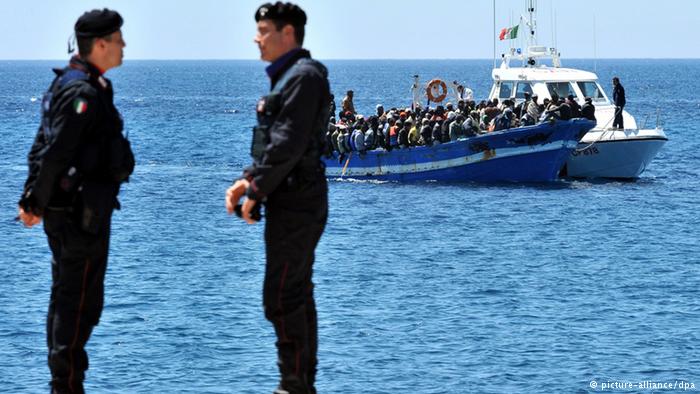
“He climbed aboard the frigate, […] aware that a fight was about to take place and that men, on the bulging back of the sea, are nothing”
(Eldorado, Laurent Gaudé, Babel, page 71)
Who is the figure hidden behind this “he”? Is it Salvatore Piracci, commanding officer of an Italian warship whose mission is to look after the citadel Europe against the repeated assaults of the sea? Or might it be Soleiman, storming the European forteress in a frail skiff, taking with him visions of his past life, taking with him the unwavering hope of a better life, far from the poverty and terror of his home country?
Nothing indicates such a departure. Salvatore strolls around in an Italian market. Daily gestures continuously repeated, the sale of fish, the purchase of a certain species rather than another, trite discussions… Words and sentences thrown out through open outcries, that gain bit by bit a symbolic importance. (“So officer, we were touched by a ghost?”, page 11) Then, a figure comes to disrupt the spirit of the soldier, a familiar figure. A main figure in the book, who casts doubts in the functional spirit of our officer. This doubt, which will chase him throughout the book, will also be the starting point of a wholly different journey …
On the other side of the sea, Soleiman drinks his last coffee, in the last bistro that he will go to on his home continent. He shares his last glances, his last sighs, his last words also with his brother Jamal. Then, a mad race, a car that ran out of gas which concludes the feeling of liberty, and we have to go back on the road. Crossing the border to Libya and (perhaps is it not as easy) board the makeshift boat, with unknown fellow travelers but who share the same Destiny and the same dreams.
Organised into very short scenes grouped into seven chapters, into seven acts, the book allows the reader to gravitate around symbolic sites: the Catane, Lampedusa, Ghardaïa, Al-Zuwarah. Sites described with a lifeblood, that outlines every landscapes, the shadow of a tree on the African coasts, the sound of waves running ashore on the Italian lands, the tribulations of travelers atop the bitter abysses.
We recognize the author’s privileged themes, already tackled in his novels and theatre plays. Remember the theme of exile, particularly explored in Le Soleil des Scorta. (Babel, pages 92-93 and following) We could also risk a historical parallel between the transatlantic journeys of the XIX-XXth centuries and the trans-Mediterranean journeys of the beginning of this XXIst century. Parallel that could confirm the poem of Emma Lazarus, graved unto the stoned pedestal of the Statue of Liberty.
“[…] Give me your tired, your poor,
Your huddled masses yearning to breathe free,
The wretched refuse of your teeming shore.
Send these, the homeless, tempest-tost to me,
I lift my lamp beside the golden door!”
Will Europe be, as was she, capable of lifting her lamp beside the golden door?
But remember also the omnipresence of death, presented in Le Tigre Bleu de l’Euphrate (Babel, pages 138-139), theme explored once again in the book.
Reading such a book in today’s context turns out to be extremely insightful, the realism being so strong and the presented figures being so human. We learn from it the daily lives of the men of the sea, those who navigate through it in safety to save – and the word is not too strong – the surcharged rowing boats, the ships crumbling under the weight of the refugees’ hopes.
The intertwined destinies of characters evolving in the big Mediterranean fresco, Eldorado is one of those books whose intrigue and style are remarkable, and that we close – not without a certain sorrow – thinking that “here is the fight of night and day…”
Journalist : Pierre SIBUT-BOURDE
Translator : John GORDON
MUN for « Seconde » students in Lycée de Ferney-Voltaire
The registration meeting will be on Wednesday, September 23rd at 2.30 pm or 3.30 pm room 104. If you are in Seconde and if you would like to join MUN, please come to one of the two meetings. Before the meeting you need to register and send a motivation letter.
More information here
UNEP is talking about us in its last newsletter
Click
The COP21 project
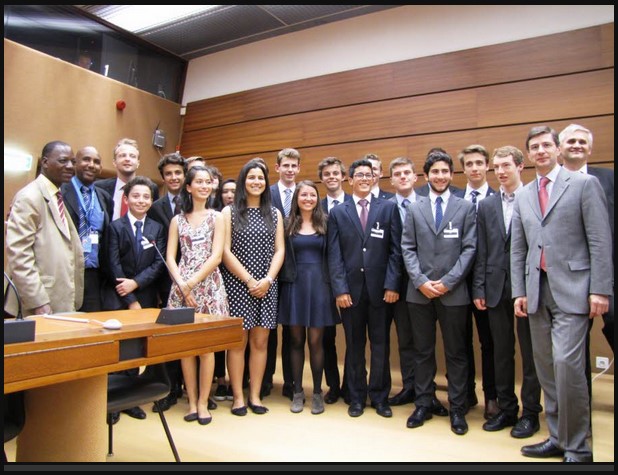
Applause, thanks and enthusiasm have been the conference’s watchwords of the 3rd of June, at the UN. The students of the COP21 project, accompanied by other members of the MUN association, had arranged a meeting with ambassadors wanting to know more about the involvement of young people in major projects.
Mr Dusik, the Regional Director of the United Nations Environment Programme, accompanied by Mr Niemtchinow, Representative of the Permanent Mission of France to the Unites Nations in Geneva, have been invited to the appeal to action of the Lycée de Ferney-Voltaire. Students and their teacher Mr Kastler, who supervised the project, completed the tribune. Edouard Labarthe was the president of the session, supported by Omar Boutallaka, Kelly Laugier and Sacha Krajcik, three of the driving forces of the project. Kilian Bartsch, Secretary General of the conference FerMUN 2016 and his Deputy Sara Luzzatto were also sitting next to the president, to represent the general investment of the association. Mr Ramet, Environment Counsellor of the Permanent Mission of France, initiator of our participation in the project, unintentionally missed the ceremony.
The main goal of the association Model of United Nations ( MUN) is to envolve young people in the actual world, and to make them participate in actions which maybe determine our future. In an eloquent speech, Kilian recalled these basic principles, by switching between English and French in a very skilful way. By doing so, he stressed the importance of the usage of those basic languages of our organisation. Mr Dusik and Mr Niemtchinow, impressed by this speech, warmly thanked us for our “out of the ordinary” motivation.
Mr Kastler, leader of this project, mentioned the “open school” of Jean Zay, the former Minister of National Education of France, recently interred at the Panthéon. He made the link between our association and the open-mindedness it brings to its members. He ended his speech by explaining that MUN makes one work on the form rather then the content, as the ideas, even simple ones, are always there.
Following on Mr Kastler’s speech, the Deputy Secretary General of FerMUN, Sara Luzzatto, specified, that students were even more motivated to build this project since the themes were in agreement with the FerMUN2014 conference. During this conference delegates tried to find solutions pertaining to the environment subject. The video giving a preview of the content of the written appeal to action, realised and presented by Sacha Krajcik, turn out to be really moving. Actors of the project COP21 recited verses describing the actual situation of our planet and in order to trigger awareness but also to provoke a certain optimism amongst the spectators. The video was an oral and direct “ appeal “, to be considered before looking at the written project.
Omar Boutallaka and Kelly Laugier wished to underline that FERMUN 2016 is committed to do more in the area of sustainable development, dedicating two of its committees of the conference to this subject. The students are particularly interested in these projects, which are influenced by our patron, the famous philosopher Voltaire. His story Candide recommended: « Cultivate your vegetable gardens ». Inspired by this idea, the Lycée International of Ferney-Voltaire has its own vegetable garden. This demonstrates that all the students, not only the member of the association, have understood what is at stake for the next years.
At the end of the presentation time was dedicated to questions and answers, which was an opportunity for some guests to learn more about the project. Mr Dusik wanted to know what subjects were of most interest for young people, and Omar responded that all topics were important, adding that for him, the transition to renewable energy was an obligatory move to create the ecology of tomorrow. The representative of La Francophonie wanted to know more about the admission and integration of non-francophone students at the conference. In response, the Secretary General reminded everyone of the hard work of the interpreters, one of the specificities of FerMun, and the international scope of the lycée. The statement was welcomed by the Ambassador.
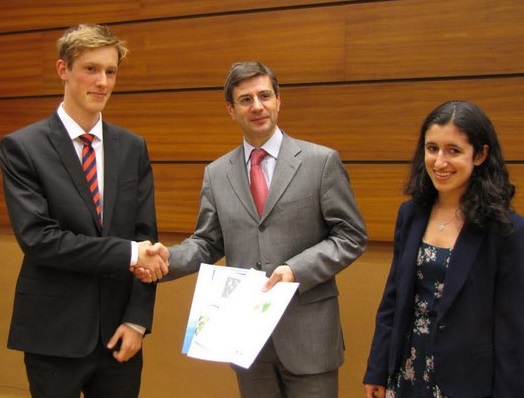
The ceremony ended with photographs of the students involved in the COP 21 project presenting the manuscript to Mr Nicolas Niemtchinow, and a group picture to mark this inspiring meeting with its promise for the future. The photographers and journalists of the press team of FerMun recorded the event for posterity. They remained active until the very end of the event, as did the interpreters in their box, thereby maintaining communication among all attendees.
Under this link you will find the full poem. Under this one you will find the video.
Journalists : Victoire Saugnac and Lucas Laurent
Translators : Lisa Mouette and Gwedoline Dommanget