


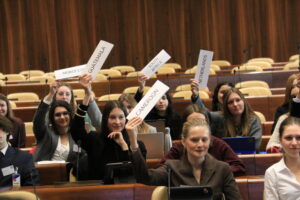
Early this morning, in a room at the ILO, the United States delegation made itself noticed by applauding and leading the entire assembly to do the same. Will their enthusiasm and ability to rally the group succeed in convincing the rest of the world to join their cause?
The creation of an international fund managed by the UN is at the heart of the debates. Funded by all states—through mineral, financial, or material resources—it would aim to redistribute medical resources fairly, particularly vaccines. Proposed by the United States, the idea quickly sparked tensions and alliance strategies.
In the ILO room, a sense of mistrust emerged. In the background: political stakes that led several delegations to form alliances opposed to the United States. “We are not with you,” declared UN OCHA as the US delegation approached. This explicit confrontation was later reinforced during a discussion between two delegates: “No one wants you, no one trusts you.” Doctors Without Borders shared the same viewpoint, voicing doubts about the intentions of the United States delegation. According to them: “They don’t need resources” and “they are unilateral and only want the benefits.”
Bringing Everyone Together for Health
Nevertheless, some delegations, such as Brazil, wished to form alliances with more developed countries like the United States but feared they did not share the same values. This lack of trust led to the formation of a strong alliance among the majority of delegations. It was notably led by the Pakistan delegation and supported by the Philippines, who, with a small embarrassed smile, said: “The United States makes promises, but their current government leads us to believe that these promises are not intended to help developing countries.”The United States delegation defended its position to ease tensions: “We do not want war; we want to bring everyone together for health.” However, other delegations seriously doubted their intentions. China, for example, found their promises paradoxical, given that it had cut UN funding.
The US delegation highlighted the gap between politics and ideology: “Health issues are international and therefore completely separate from politics.” For them—and for many of their opponents—“The only solution is multilateralism.”
Chloé Arnaud and Lilou Fréchet