



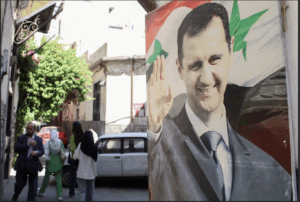
Damascus, October 2025 – After more than thirteen years of civil war and the fall of Bashar al-Assad’s regime in December 2024, Syria is struggling to recover. Marked by violence, community divisions and foreign interference, the country is entering a phase of political transition that is as delicate as it is uncertain. Between hopes for reconstruction and fears of new clashes, the international community, and first and foremost the United Nations, are playing a crucial role in preventing a return to war and supporting Syria on its path to lasting peace.
It all began in March 2011, in the wake of the Arab Spring, a wave of protests that swept across several countries in the Arab world. Thousands of Syrians took to the streets to demand greater freedom and democracy. The regime of Bashar al-Assad, heir to a family dictatorship that had lasted more than forty years, responded with bloody repression. The peaceful demonstrations quickly degenerated into civil war, then into international conflict, involving foreign powers: Russia and Iran supported the regime, while Turkey and the United States backed various opposition groups.
This war of unprecedented violence has left more than 500,000 dead, millions wounded and displaced, and a country in ruins. The Islamic State (IS) took advantage of the chaos to establish a lasting presence, adding a terrorist dimension to the conflict. Despite successive military victories by the regime, supported by Moscow and Tehran, the humanitarian and economic situation continued to deteriorate. In December 2024, a lightning offensive led by the Hayat Tahrir al-Sham (HTS) group and its allies brought an end to Assad’s reign, forcing him to flee the country. Since then, Syria has been ruled by a transitional government, but tensions remain high between rival factions and divided communities.
From the early years of the conflict, the UN has been working to find a diplomatic solution. In 2011, it stepped up its mediation efforts and created several mechanisms to document war crimes and human rights violations, such as the International, Impartial and Independent Mechanism (IIIM) and a short-lived monitoring mission. Despite recurring deadlocks in the Security Council, notably due to Russian and Chinese vetoes, the UN maintains dialogue with all parties and supports transitional justice initiatives.
Following Assad’s fall, UN Secretary-General António Guterres welcomed ‘a historic opportunity for Syrians to build a stable and peaceful future’, while recalling the immense challenges that remain: reconstruction, national reconciliation, justice for victims and the inclusion of all components of society. The UN Special Envoy for Syria, Geir O. Pedersen, emphasised the need for an inclusive political transition, without which the risk of a return to violence remains high.
On the ground, the UN continues to coordinate humanitarian aid. However, funding remains dramatically insufficient: in 2025, less than 10% of humanitarian needs are covered, jeopardising the survival of millions of Syrians.
Elio Do Vale Martins