



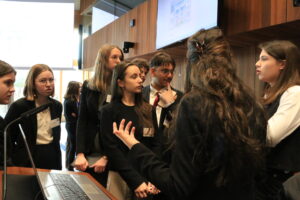
7 January 2025. Tensions are growing in Room IX of the ILO. The United States is at the centre of discussions, despite receiving surprising criticism for its stance on working conditions. Some major powers are divided, with opinions differing.
Maintaining a balance between the health of artists and athletes and the economic interests of the country is the objective of the Chinese employers’ delegation. It then reveals the emergence of conflicts between the American and Chinese governments.
The Russian government delegation expressed its desire to raise awareness about artists’ mental health. It emphasised the importance of addressing the shortcomings of the freelance system, particularly in the entertainment industry. Unsurprisingly, Russia refused to join forces with the United States. But the reason was unexpected, to say the least: the Russian government highlighted a contrast between the ideas and objectives of the two countries, stating that the United States favours the minimum wage and that ‘workers’ rights are not widely respected’. The debates revealed a striking paradox: Russia called out the United States for its failure to respect human rights, a symbolic reversal for a country long considered a model of democracy.
On the other hand, Russia has formed an alliance with the Saudi Arabian government. According to the latter, “the relationship between the state and workers is not very well developed”. He admits that his country faces various problems and that working conditions present a real challenge. The Saudi government has acknowledged its difficulties in forming alliances during the lobbying phase. Could this be evidence of a lack of integration of developing countries in international decision-making? Despite this, the state has allied itself with Russia and China, while rejecting Europe and the United States – criticised not only by members of the international community, but also by their own workers.
They particularly highlight the mistreatment of workers by employers, who use language as a tool for destabilisation.
A disorder in priorities
It was also this delegation of American workers that caused a stir in the assembly by attempting to ally itself with the Chinese and Russian governments, fundamental enemies of its country. Although this was rejected by the presidency as unrealistic, there is a clear divide between the American government and its workers.
Faced with the crisis in working conditions, we can almost speak of a coalition of emerging and developing countries against the United States, criticising a disorder in their priorities regarding the conditions of their workers. Can we talk about propaganda on the part of Russia, China and Saudi Arabia? Or, on the contrary, are we really witnessing a reversal of geopolitical situations? Are the United States, once the world’s policeman, now disrupting human rights? One might also wonder whether the FerMUN debates accurately reflect reality, or whether they are merely a simulation produced by students who sometimes take liberties with the actual positions of the countries they represent. The finalisation of the resolution may answer these questions.
Hélène Khukhunaishvili & Agathe Sanchez