


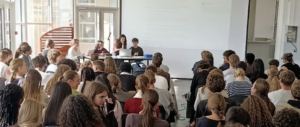
October 14, 2027, marks the day when FERMUN became, for a brief moment, more than just a Model UN simulation. While high school protests and demands are monopolizing the news, students from the Lycée de Ferney-Voltaire gather to draft a resolution proposing local solutions. Following the damages caused by certain high school blockades, the Ministry of Education wants to prioritize discussion at all costs. But is discussion always enough in the face of high school student frustration?
Fear for the Future
The high school student movement is partly fueled by a general apprehension about the future and higher education. The debate becomes heated at the mention of Parcoursup, a tool that the original resolution asked to abolish. Lucia opposes this proposal, explaining that Parcoursup is deeply rooted in the national education system and that abolishing it goes beyond our scale. With the uproar and frustrated faces provoked by this statement, it is clear that Lucia’s opinion is not universally shared. Other students point out the numerous negative feedback reports regarding Parcoursup. Among them, one student gives the example of an application where a recipe was submitted as a motivation letter and supposedly accepted into a psychology department. However, others like Lily feel that “abolishing Parcoursup would take us back to the Stone Age administratively,” calling the platform an “incredible tool” that simplifies higher education applications. This debate is far from homogeneous. Out of fear of not receiving a spot in any university, some call for an alternative platform to Parcoursup, while others want to overhaul the existing one. The amendment against the abolition of Parcoursup ended up passing, with 54 votes in favor and 23 against. Perhaps, despite this fear for the future, a total upheaval of the current system causes even greater anxiety. Or perhaps the students realize the difficulty of modifying the national education system on their own scale.
“School is here to guarantee equal opportunity”
Charlotte intervenes to strike down a clause that aimed to create classes of different levels for students. A debate ensues, prompting everyone to reflect on the priorities of the school system: should the focus be on teaching efficiency by adapting classes to each individual’s level, or is equality among all students more important? Charlotte reminds everyone that “school is here to guarantee equal opportunity, not to organize a hierarchy,” and insists on the harmful consequences such a measure would have on self-esteem. She also highlights the current context: while high school students stand united to make their voices heard, establishing a system of exclusion would be counterproductive. Solidarity is a value to be cherished for her and many others. This is why Charlotte proposes an alternative to the clause: encouraging peer tutoring and highlighting support hours. Other delegates point out the positive aspects of a leveled class system, which they believe could solve the problem of students lacking concentration. However, according to the principal, Mr. Tedde, such a system remains “completely illegal.” The law seems to be at the heart of recent debates, touching on the freedom to protest, the right to assembly, and the growing violence in France over the past few weeks. Everyone’s moral compass is being questioned as people wonder how far police can go to maintain order and security, and how far protesters can go to achieve change.
The Ferney-Voltaire resolution passed, despite the dissatisfaction expressed by some students. While a great deal of work was accomplished, the resolution remains incomplete. It fails to address certain major demands, such as the shortage of teachers, as Eulalie pointed out. Over the course of these two hours, the context of the debate was frequently discussed: since the resolution had to be restricted to solutions that could be implemented locally, some major problems were difficult to resolve. Are the solutions proposed by the FERMUN students relevant enough given the magnitude of the stakes? Will these solutions actually be implemented? It is hard to say.
Hélène Khukhunaishvili