



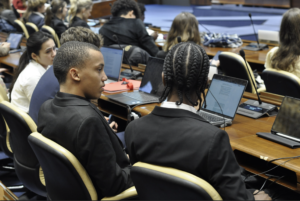
Today, the atmosphere was electric in the WHO Committee at FerMUN 2026. Between ideological disagreements and debates over resources, delegations fought passionately to define the future of health and the safety of individuals exposed to violence.
Afghanistan made a strong impression with a radical stance: according to them, money is not the problem. They even stated their desire to “replace resources with more protection.” For this delegation, only strict laws can guarantee women’s mental health.
Meanwhile, the Russian Federation and Nigeria warned against “police-phobia.” They argued that giving the police too much freedom creates disorder and scares victims, who then hesitate to report their attackers. Later, Romania highlighted a tragic reality: 90% of complaints are dismissed due to lack of evidence. However, their proposed amendment on the issue was rejected by the majority.
The debate then turned to how to provide healthcare to disadvantaged populations. Romania and Eswatini discussed the intervention of Médecins Sans Frontières (MSF). While the idea of an aid fund is appealing, many countries fear that relying solely on international assistance would create dependency. For these skeptical or resistant countries, the objective is clear: local health systems must be strengthened rather than relying exclusively on the WHO.
The breaking point came with India’s proposal to consider abortion as a mere hygiene and health procedure. Afghanistan deemed this perspective “definitely Western” and incompatible with their social and cultural realities. Nonetheless, Senegal and Sweden managed to pass a crucial amendment encouraging safe access to abortion and contraception in cases of sexual violence, aiming to prevent tragic deaths linked to sexual violence or unsafe practices.
At the end of the amendment session, Pakistan advocated for more inclusive language. Thanks to their intervention, supported by Romania, the final text now explicitly mentions orphans and war-affected children, along with all other children, who are often overlooked compared to migrants or children with disabilities.
Yasmine Akkabi