



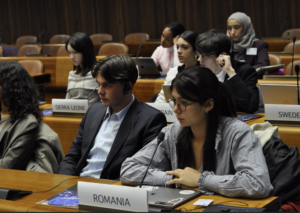
It is Thursday, January 8, 2026, and in Room II of the ILO, where the committee on the informal economy is meeting, delegates are hanging on every word of Florence Bonnet. A specialist in labour markets and the informal economy at the ILO, Ms. Bonnet addressed the committee in order to guide delegates in their debates. She notably provided valuable advice on the resolution put forward by the Mexican Workers’ Delegation, while emphasizing that the proposals made by the various delegations were already “very accurate and very well thought out.” She then answered many questions, both on the factors that can contribute to an increase in the share of the informal economy within a country, and on the place of migrants in this economy, who are often heavily affected by informal employment. One delegate, perhaps idealistic, asked whether it was conceivable that the informal economy might one day disappear entirely. The specialist replied by recalling the evolving and dynamic nature of the informal economy, making its disappearance unlikely, if not impossible, in her view. Following this moment of dialogue, Ms. Bonnet kindly agreed to speak with the press team.
FERMUN : What progress can be observed today in the formalization of work?
Florence Bonnet: Today, countries and policymakers who are in a position to act have a much better understanding of the informal economy, the drivers of informality, and the available policy tools than they did ten years ago. The adoption of Resolution 204 in particular has guided countries toward a better understanding of informality, including ways to improve conditions within the informal economy. This resolution was followed by extensive work on awareness-raising, diagnostics, research, and analysis, which has also greatly improved over the past 10 to 20 years, enabling this deeper understanding.
FERMUN: What is your view on the development of supply chains?
Florence Bonnet : Global supply chains are at risk of becoming informalized, but they also represent a means of providing those at the bottom of the chain—such as small producers or small entrepreneurs—with access to training, tools, and potentially to formalization.
FERMUN: In terms of social protection, have there been advances in recent years?
Florence Bonnet : There has clearly been an extension of social protection beyond formal salaried employment. As the delegates mentioned, both administrative and financial barriers to access are now being taken into account. Thanks to a better understanding of the issue and to the development of mechanisms facilitating access to social protection for groups that were previously excluded, it has been possible to focus on the obstacles to social protection.
FERMUN: How has the ILO been affected by the growing awareness you mentioned?
Florence Bonnet : For many years, when looking at ILO standards, they were largely focused on the formal relationship between employers and workers, which only concerns part of the informal economy. Awareness has therefore also grown here, and subsequently gained increasing importance within countries, among policymakers, and among all those who are in a position to make a difference.
FERMUN: What advice would you give to the delegates present here as debates continue on the second issue, concerning abuses against workers in the informal economy?
Florence Bonnet : As I said, there are different contexts—that is, forms of informality and reasons for informality vary depending on the country in which workers operate. I think it is important to start by fully understanding the nature of the informal economy in many countries, the predominant forms of informality, and the drivers of informality, in order to know what to act on and how to act.
FERMUN: Will delegates be able to rely on recent conventions to support their arguments?
Florence Bonnet : A convention and a recommendation was adopted by the ILO in 2019 on violence and harassment in the world of work. They are among the few instruments that explicitly state that they apply to the informal economy. There are not many such conventions. It is important to keep in mind that they apply not only to the formal economy but also to the informal economy. One must therefore consider ways to prevent and address violence and harassment in the informal economy.
FERMUN: In what contexts can abuses occur?
Florence Bonnet : In the informal economy, this concerns the workplace, but also the street and markets. It is broad, and it is important to take this into account. You can also turn to the ILO, which collects good practices, seeks to understand what is being done, and builds its own capacity to support you.
FERMUN: Which informal economy workers are most affected by these abuses?
Florence Bonnet : In this second issue, you will often be able to refer to domestic workers. If you have not yet ratified Convention No. 189, which supports them, do not hesitate to do so!
Cyrielle Bouline – Elisa Develay