



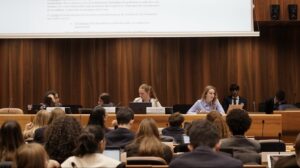
In Room II of the International Labour Organization, Jasmine, Charlotte, and Rita, committee chairs for FerMUN 2026, are preparing to oversee debates on the informal economy. On this first day, discussions focus on how countries can promote access to social protection for all individuals working in the grey economy.
At 11:53 a.m., the silence that has settled over the room is broken only by the movement of admins carrying messages from one delegate to another. It is time for delegates to draft their amendments, following a relatively eventful lobbying phase that led to the formation of two alliances. On one side, governments and workers, along with some employers from developed and occasionally emerging countries, seek to formalize the informal economy in order to make access to social protection administratively easier for the workers concerned. As stated by the delegation of the U.S. government: “No formalization of the economy, no social protection.” Opposing them are governments and employers from emerging countries, whose economies largely depend on the grey economy, as well as some workers, who believe that the methods proposed by developed countries—often less affected by informal economies—are too harsh. This is precisely the position of the Chinese employers’ delegation, which advocates for the gradual formalization of informal jobs in order to progressively reduce the informal economy, while constantly seeking economic stability.
A Generally Calm Assembly
“90% of Ethiopia’s economy is informal,” declared Ethiopian workers and employers. This explains their desire to transform the informal economy in order to secure better wages and improved working conditions for workers. Within the first session, some disagreements emerged, particularly between developed and emerging countries over the issue of financing certain measures. Ultimately, the countries concerned reached a consensus through dialogue, concretely illustrating the core values of the United Nations. Despite these disagreements, the assembly remained relatively calm—perhaps too calm, according to the committee chairs. They noted a slight lack of confrontation between differing viewpoints, as well as alliances that do not always seem aligned with the positions of the countries represented. This is notably the case with alliances between employers and workers, who often have opposing interests. Perhaps these interests will begin to surface during the open debate phase, weakening the alliance formed earlier.
Cyrielle Bouline & Djabeur Chahine