


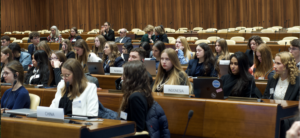
It is January 8, 2025, in Room GB of the new committee of the World Health Organization. This committee demonstrates its importance from the very beginning of the debates. Not only are 36 countries gathered, but also three major international organizations, in order to find solutions to two key challenges: pandemic preparedness and the fight against violence against women and children. Many argue that global cooperation is necessary, but does this not risk encroaching on the national sovereignty of states? What should be prioritized? Countries’ positions diverge. An interview with several delegations and an international organization.
FERMUN : Do you agree with the idea that each country’s problems should be solved solely by the state concerned, or do you think that states with greater resources should play a major role in preparing others, particularly in the face of pandemics?
India: Each country is responsible for its population, but it must be taken into account that pandemics respect neither borders nor levels of development. Some countries with greater resources have a responsibility to provide assistance to others.
Senegal: If assistance is possible, it must of course be offered. Some countries do not have the necessary resources, while others possess them in considerable quantities. If Senegal has access to this aid, it will be able to develop further and thus focus more on trade in the future.
Sweden: We believe that states should collaborate as much as possible to ensure peace. Countries with more resources and experience regarding certain issues play a key role in helping developing countries. Sweden is an excellent example: it is an innovative country with financial and scientific resources. We are also strongly committed to UN and WHO initiatives.
Office for Humanitarian Affairs: We are concerned about the power that certain countries could hold over weaker ones. Each state must be heard and listened to, and our role as a mediator must guarantee this. We do not believe that standardized solutions are sufficient to prevent global crises.
FERMUN: Could your country be among those bearing such responsibilities, considering your financial capacities and the domestic situation?
India: In terms of financial resources, we would like to be in a much better position. As for the situation in our country, unfortunately there are many inequalities within the population: violence against women (with a high number of rapes) as well as against children (who are abused or abandoned).
Senegal: One cannot say that our country has no wealth. Proof of this is that Senegal’s resources were constantly exploited by colonial powers. But today, obtaining even minimal assistance is a major challenge. We are not in a position to prioritize international trade at the expense of our population’s survival.
Sweden: Certainly. Our country is especially committed to the fight against violence against women.
FERMUN : Should your state’s national sovereignty take precedence over global health security?
India: Even though it remains fundamental, national sovereignty cannot serve as a pretext to ignore global health risks. Global health security can even strengthen each country’s national sovereignty. India defends a form of sovereignty exercised within international organizations, particularly the WHO.
Senegal: No, this sovereignty does not apply equally to all. Prioritizing national sovereignty by the most powerful countries would lead to a global danger, including for those states themselves. For small countries like ours, the issue is not power, but survival.
Sweden: It cannot be put that way. The two must complement and balance each other. The problem is that sovereignty sometimes runs counter to global security: national sovereignty can compromise access to healthcare for certain populations. The entire challenge lies in finding a balance.
Office for Humanitarian Affairs: In order to live together, communication is essential. Our organization is built around acceptance and, above all, neutrality of power. A mediator like us is indispensable for negotiations on important issues, but above all there must be openness toward others.
FERMUN: Do you think national sovereignty and multilateralism can coexist?
India: Absolutely. India is an example of this coexistence: we are a major democracy committed to multilateralism. Multilateralism does not erase sovereignty.
Sweden: Even though challenges exist, our country believes that coexistence is possible. It is above all a matter of work, in order to reach agreements and collaborate—a process that takes time. To move toward an ideal world, mutual respect between countries must be established.
Senegal: Of course, receiving assistance to enable better development is necessary. But once the aid has ended, the country should not feel “enslaved” to the assisting country. In the future, we hope to see the emergence of ties that are not only financial, but deeper.
Office for Humanitarian Affairs: Our way of operating is based on the very principle of multilateralism, whether in terms of funding or work. The goal is to respect identities and to succeed in addressing sensitive issues in the most concrete way possible.
FERMUN : Have you witnessed the formation of unlikely alliances? Or, on the contrary, have you observed unexpected tensions?
India: We ourselves formed an alliance with Pakistan, which may be surprising given our historical conflicts. But when it comes to health, these conflicts must be overcome.
Sweden: We were surprised by the role played by the American delegation: it did not reflect the current policy of the state. Other countries also surprised us by proposing an alliance, notably India or Saudi Arabia. We believed that their values were very far from ours, particularly on a religious level. Yet this perhaps shows that countries know each other poorly politically, or that preconceived ideas influence our perceptions, making this alliance ultimately less surprising than it seems.
Senegal: We allied ourselves with Cameroon because of our similar problems and a shared need for assistance. Both our countries want change—we are therefore ready to fight together against violence against women and the lack of medical care. This struggle is necessary for the development of our countries. However, this cooperation also highlights strong inequalities, including within the African continent, where some countries lack basic necessities while others live in opulence and in the overexploitation of resources, which can generate unexpected tensions.
Hélène Khukhunaishvili