



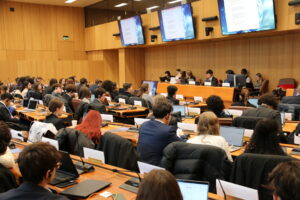
Within the International Labour Organization, in the Committee on Working Conditions, delegates debated the first key issue: how to guarantee people working in the arts and entertainment sectors protection against job insecurity and physical and psychosocial risks. During this debate, the press team was able to ask questions to the employers of Spain and to the government of the Russian Federation, spokespersons for the two different draft resolutions.
SOLENE KREMSER: According to your delegation, what are today the main physical, psychosocial, and professional risks faced by workers in the arts and entertainment sectors?
RUSS GVT: For the Russian government, the main risks concern mental health. Indeed, in Russia, workers are covered, including those working in the performing arts and entertainment sectors. Freelance workers, however, are not covered in the field of mental health. Nevertheless, mental health is a topic that is very rarely addressed in Russia, which is why it will be a priority in this debate.
EMP ESP: Indeed, they face many risks, such as social or financial exclusion, due to their low and irregular pay. Their professions are often considered as passions or voluntary work.
JUDITH GINGOLD: Some States believe that the creation of a new UN organization such as UN ART is costly. How do you justify its necessity?
RUSS GVT: The creation of new structures is unnecessary, just like the creation of new organizations such as UN ART. We discussed this during an information point on the first resolution: our delegation does not see the point of creating new structures when the United Nations already has several, and in various fields. This is far too costly and requires excessive administrative organization.
EMP ESP: Unlike the delegation of the Russian government, we believe that UN ART is necessary. However, we recognize the importance of the costs involved and therefore propose advertising campaigns to enable the creation of this crucial organization. The idea would be to offer artists training and retraining programs, as well as tools that would allow them to manage their problems through forums.
S.K.: The MIND-C program (Mental Inclusion and Development for Creators) and discussion groups are strongly emphasized in these resolutions. Why is there such a focus on mental health?
RUSS GVT: Mental health is essential both for artists and for the quality of artistic and entertainment productions. Workers in these two fields are exposed to high levels of stress, professional uncertainty, psychological pressure, and sometimes social isolation.
EMP ESP: In Spain, we say that “there is no health without mental health.” Mental health is one of the best ways to move this issue forward. Many delegations agree on its importance, and it is a way to find solutions that are more or less acceptable to everyone.
J.G.: How would an international fund financed by the G20, proposed by delegates during the debates, help reduce inequalities between developed and emerging countries within the cultural sector?
RUSS GVT: This international fund represents concrete solidarity. It provides financial resources to countries that lack them and that do not have the budgetary capacity to financially support artists.
EMP ESP: Giving to countries in order to reduce inequalities is important, because some countries do not have the means to help their artists. The problem is that this issue is not at the heart of international discussions, and funds therefore do not benefit artists, even though this is an essential and significant issue. We find this truly regrettable and believe that it deserves to be studied by the entire international community.
S.K.: What would be the advantage of creating a specific branch of the ILO for the protection of arts and entertainment workers rather than strengthening existing mechanisms?
RUSS GVT: We believe that this would allow for more targeted expertise adapted to artists.
EMP ESP: Existing mechanisms for artists are very rare, and it is therefore necessary to create this new branch of the ILO in order to introduce a new set of actions aimed at helping artists.
J.G.: How can sustainable funding for measures to protect arts and entertainment workers be guaranteed without penalizing national budgets?
RUSS GVT: To ensure sustainable funding, we must rely on a percentage of GDP that will depend on each country and will therefore be adapted to its economic capacity.
EMP ESP: The best approach for our delegation is to promote awareness and cooperation, as requested by the UN. We could propose advertising campaigns so that individuals, companies, and wealthy countries can support countries with fewer resources. This process would of course be voluntary, in line with UN values, where cooperation takes precedence.
S.K.: Why should the protection of arts and entertainment workers be an international priority today?
RUSS GVT: Today, we all consume culture. It is not only a right, but also a freedom, which we must protect for both men and women.
EMP ESP: Artists suffer greatly and are very rarely taken into account, even though their art contributes to everyone’s mental health. This is why the protection of workers should be essential in contemporary international issues.
J.G.: What balance should be found between the responsibility of governments and that of employers to guarantee decent working conditions in this sector?
RUSS GVT: In our view, the key is communication. There is a huge lack of communication between employers, governments, and employees, which hinders the adoption of measures that cover tripartite interests.
EMP ESP: Employers who contribute to the functioning of the economy need a framework with few economic constraints. A balance must be found between these constraints and decent working conditions, which must be granted to artists. A middle ground must be found in order to preserve the voluntary nature on which UN cooperation is based, even though this is difficult.
S.K.: Physical risks are often underestimated in artistic professions. Which preventive measures should be prioritized?
EMP ESP: Physical risks can be caused by a lack of prevention. Violence and harassment can be addressed through several of our proposals, such as the creation of a regional or international hotline allowing artists to speak out about the violence they have suffered. Discussing this issue shows us that there is far more violence than we think, and this awareness allows us to place their cause at the heart of international discussions, which encourages action.