


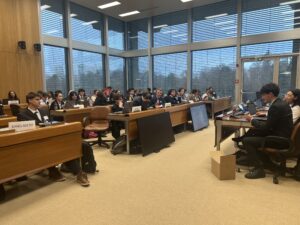
It is 11 a.m. when the Haitian delegation is faced with a crucial choice.
A choice that repeatedly emerges in FAO debates: should ecology be prioritized when a country is regularly struck by climate disruption, natural disasters, and environmental shocks? Or should the economy take precedence when a nation is among the most vulnerable in the world? For Haiti, this dilemma is anything but abstract. Agriculture forms the very foundation of the country’s survival, both economically and socially. An overly rapid ecological transition could worsen poverty and food insecurity. The Haitian delegation sums it up clearly: “Without economic development, it is impossible to implement true ecology.”
Thus, Haiti argues that economic development must come before ecology—not out of disregard for the environment, but because without financial stability, no sustainable transition is possible. This position makes Haiti a starting point for understanding the divisions running through the committee. In vulnerable countries, ecology can be seen as an objective, but not as an immediate priority. Haiti is not an isolated case. Countries such as Bangladesh, Ethiopia, and Kenya face the same reality. These states are among the most affected by climate change, while having very limited means to respond to it. All acknowledge the importance of ecology, but their priority remains clear: feeding their population and ensuring a minimum level of stability. For them, ecology is a long-term goal that can only be achieved with strong financial and technical support from the international community. As one African delegate stated during the debates: “You cannot protect the environment when you are already struggling to survive.” For developed countries, ecology is an assumed priority. Nations such as Germany, France, Canada, and Japan clearly place environmental concerns at the heart of their agricultural policies. Thanks to their financial resources, research capacities, and technologies, these countries can invest in sustainable agriculture without jeopardizing their economies. Their vision is based on a rapid, structured, and regulated transition. The German delegation summed up this approach with a phrase that became central to the debates: “We must produce more cleanly, but not produce less.” Between these two blocs stand emerging countries such as Brazil, India, China, and Mexico. Their position is more nuanced. These nations aim to make ecological progress without slowing their economic development or undermining their role in global food supply. They advocate for a gradual transition, adapted to national realities, and based on innovation and cooperation. For them, it is not a matter of choosing between ecology and economy, but of advancing both simultaneously. Finally, some wealthy countries such as Qatar or Saudi Arabia place primary emphasis on economic security and international trade. Their strategy relies on technological innovation and commerce to guarantee stable access to food. For these states, ecology matters, but it must never threaten economic stability or immediate food security. As the debates unfold, one idea becomes clear: the real divide is not between ecology and economy, but between countries that can afford an immediate transition and those that must first survive. The FAO thus reveals a deep global fracture, where the ecological transition cannot be uniform. It must take into account the economic realities of each state, or risk further exacerbating inequalities between countries.
Mathys Pastel