



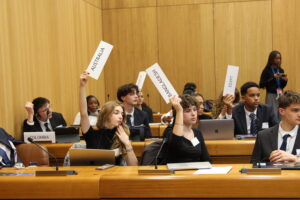
Meeting within the International Labour Organization (ILO), the FAO committee debated ways to sustainably feed a growing global population. The discussions and adopted resolutions highlighted alliances between states, structured around agricultural innovation, local adaptation, and international cooperation in the face of food insecurity.
Over the past 50 years, the world population has grown from 2.5 billion in 1950 to 8.4 billion in 2024, leading to a sharp increase in food demand, while food insecurity has risen by 30%. This ever-growing demand has driven intensive agricultural productivity, characterized by the use of pesticides and the conversion of land into arable fields. The international community is facing a central dilemma: meeting rising food needs while ensuring food security, all while respecting environmental limits and sustainability imperatives.
Created around 10 a.m., the two different resolutions presented by Germany and Russia illustrate a collective response to this challenge by organizing more or less durable alliances between states around shared priorities.
In the first resolution, an initial bloc of allies formed around Germany, France, Canada, Japan, and Italy, who share common visions such as research, innovation, and support for the Sustainable Development Goals defined by the United Nations. These alliances are shaped by the clauses that define them. For example, Clause 8, introduced by Germany, calls for the creation of a UN-controlled global research center aimed at developing efficient and sustainable agricultural practices. Clause 11, proposed by France, reinforces this momentum through the creation of a Global Fund for Sustainable Agriculture. Added to this are Clauses 9 and 10, put forward by Japan, which call for the publication of annual reports on sustainable food production as well as education programs for farmers and consumers. Together, these clauses institutionalize a long-term alliance based on transparency and accountability.
Local Adaptation and Protection of Livelihoods
Furthermore, the resolution reflects a strong alliance among several Global South countries such as Bangladesh, Cameroon, Colombia, and Morocco. These states share vulnerability to climate hazards and a heavy dependence on agriculture for their populations. This alliance is defined by clauses centered on small-scale farmers, as well as provisions such as Clause 7, introduced by Bangladesh, encouraging the adoption of nature-based solutions. The Bangladeshi delegation warned: “Without climate adaptation, food security is at risk.” Clause 6, supported by Cameroon, emphasizes sustainable water management. Together, these clauses define a lasting alliance built on local adaptation and the protection of livelihoods.
The second resolution, introduced by Russia, led to the formation of several alliances, including one with Haiti, Ethiopia, Mexico, and Brazil. These states share a strong dependence on agriculture and vulnerability to climate shocks.
Their clauses encourage regional sharing of agricultural technologies, particularly among countries facing similar climatic conditions, thereby strengthening South–South cooperation. The focus is placed on flexible agroecology, restoration of degraded land, reduction of post-harvest losses, and strengthening local food systems. Ethiopia plays a leading role in promoting regional cooperation, soil restoration, and the reduction of pollution linked to food transportation.
These resolutions do more than propose technical solutions to the global food crisis. They outline a network of durable alliances bringing together less developed countries, emerging powers, and major agricultural actors around shared principles: cooperation, flexibility, environmental sustainability, and respect for farmers’ sovereignty. These convergences integrate technological innovation, agroecology, waste reduction, and multilateral governance. While the objectives and interests of these states may differ, collective initiative makes it possible to envision a fairer and more sustainable future, at the crossroads of agricultural worlds and innovation.
Judith Gingold