



How can we ensure that all people engaged in professional activity earn a living wage in order to guarantee a dignified existence and reduce economic disparities? In a world where inflation is constantly evolving and wages grow at different rates, the labour rights committee raises this crucial question.
On Wednesday, January 7, at the premises of the International Labour Organization, the committee on labour rights begins drafting its resolutions. Faced with major challenges, alliances and mistrust quickly start to take shape.
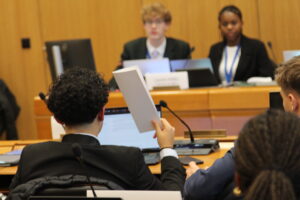
Boundaries are blurred and the general buzz fills the room. On both sides, delegates are hard at work: laptops are overheating, brows are furrowed, and resolutions begin to appear on screens. Among all these voices, Brazil stands out for its determination and draws in other emerging countries. Their objective? To reduce economic inequalities and guarantee an adequate minimum income by adopting a long-term perspective and calling for this goal to be led by a new branch of the ILO.
11:30 a.m. Alliances begin to form. However, many delegations are confused: developed countries such as Germany or the United States are aligning themselves with emerging countries. The United States remains isolated, hesitant, and avoids asserting itself in discussions. Many delegates explain this restraint by pointing to the rise in anti-American sentiment reinforced by recent international events. “I understand why the United States is aligning itself with emerging countries given recent events,” stated the government of India.
As lobbying progresses, a growing divide emerges between workers, governments, and employers. The two resolutions oppose one another. The one presented by Canada, supported by a majority of governments and employers, opts for a more restrictive approach based on controls and inspections. In contrast, Brazil’s resolution proposes numerous support mechanisms.
Despite their disagreements, delegates mingle and spread out across the room. Everyone seems open to discussion and to proposals from other countries. And if this were the very spirit of multilateralism?
A Vital Intervention
At midday, Mr. Delautre, an economist specializing in employment policies, was able to shed light for students participating in FerMUN 2026 on the issue addressed by Committee 1, during a session held in Room IV of the Labour Rights Committee. He discussed the challenges and initiatives that could influence the evolution of a living minimum wage.
“I have always been passionate about economic issues and wanted to open myself to the international sphere,” said Guillaume Delautre, a member of the ILO, explaining his decision to pursue studies in economics. He later undertook training in labour law, which enabled him to build a career within the French administration.
During this session, Mr. Delautre provided valuable insights into the work of Committee 1, which focuses on labour rights. The living wage system aims to be updated through calculations of the cost of living in each country, in order to adjust the legal minimum wage accordingly. This intervention encouraged reflection on the difficulty of personalizing minimum wages for each individual, particularly in sectors such as agriculture. During the session, he also shared experiences from his travels around the world, from Egypt to Rwanda, via Geneva. He expressed a particular appreciation for the city of Abidjan in Côte d’Ivoire.
Delegates showed great curiosity, listening attentively and asking relevant questions, which Mr. Delautre was happy to answer. Feedback on the content and perspectives shared during this hour was overwhelmingly positive. “I found the intervention enlightening, especially regarding the distinction between a living wage and a living income. It helped me better understand the situations faced by farmers, for example,” testified the Swiss government delegation.
The presence of this expert provided young delegates with new insights and important knowledge that will support them throughout the debate. An engaging exchange that brought this first morning to a thoughtful close.
Nomin SANJAAJAMTS – Dalanda Eden DIALLO