



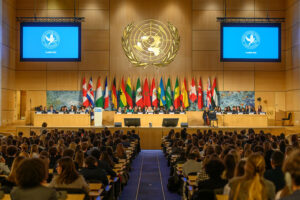
On 6 January 2026, at the United Nations Palace, the 15th FerMUN conference officially opens its doors. 610 young students from 30 schools and 17 different countries are gathered for a new, enriching and global edition. The conference’s opening ceremony is marked by strong commitment and boundless passion from all generations.
The opening ceremony of FerMUN 2026 begins with a speech by Ms Tatiana Valovaya, Director-General of the United Nations Office at Geneva. Ms Valovaya emphasises the importance of preserving the heritage and history of the United Nations, but also of finding solutions to modern challenges, such as labour rights and the informal economy. Abdul-Salam Antwi follows with an inspiring and powerful speech: in his view, students can take on the role of diplomats, because there is no age limit when it comes to taking action. Young people offer answers, food for thought and ideas for change. Abdul-Salam reminds us that the future is in the hands of young people, thanks to the articles they write, the resolutions they prepare and the amendments they make: “You are not just playing the role of a delegate or a president. You become one,” Abdul-Salam emphasises. Ms Jurgensen, France’s Permanent Representative to the United Nations, adds that multilateralism is not just a matter for diplomats and governments, but for each and every one of us.
When we talk about youth, we are not only referring to teenagers and young adults, but also to children. Mathéo, Léna and Léonie, pupils at Jean Calas Primary School, explain that at their school, they practise debating, arguing and listening to other people’s points of view. They discuss topics such as gender equality, observing gender discrimination at school. Mathéo points out that ‘even at the age of 9 or 10, we can talk about important issues.’ Several speeches thanked the directors of FerMUN, everyone’s opinion, for accompanying, encouraging and supporting us, and in particular Philippe Launay, for whom this conference is the last, to everyone’s regret.
The United Nations is overflowing with talent today.
The Devil Wears Prada and Gossip Girl, two iconic classics, feature in the opening video – the United Nations is brimming with talent and creativity today. FerMUN participants, not limiting themselves to international relations and diplomacy, excel in a variety of other fields. Ishani Petitjean and Sarra-Maya Hadiji soften the atmosphere with two remarkable guitar performances, the musical interlude being a FerMUN tradition. As for the second video, a cover of Ed Sheeran’s song Azizam, it perfectly illustrates the cosmopolitan dimension of FerMUN and the spirit of cooperation, with the participation of many schools.
Multilateralism is being challenged more than ever before.
In a world fractured by international conflicts, global warming, and even AI, multilateralism is being called into question more than ever (inter-state cooperation for decision-making, editor’s note). These speeches prompt reflection on the effectiveness of international organisations. Is the law of the strongest likely to soon dominate the world stage? This theme, at the heart of our conference, is introduced by Alain Le Roy, French Ambassador and former Deputy Secretary-General of the United Nations, along with four young students who won the FerMUN public speaking competition. Mr. Le Roy provides a profound and enlightening explanation with historical background on the subject. He defends the effectiveness and legitimacy of the UN, even though some crises are difficult to resolve. “Of course, the UN is not perfect, but when it is not there, it is even more catastrophic.” According to him, the solution is to reform the UN, not to dissolve it.
As for the young people’s comments, they demonstrate our generation’s commitment and willingness to take responsibility, with condemnation of broken agreements and criticism of the UN Security Council, but also the importance of understanding other people’s points of view and not seeing difference as an obstacle. One student mentions the impact of social media and AI on young people’s patience, which is wearing thin in the face of unresolved crises. She nevertheless points out that Generation Z remains an ‘optimistic generation’. Another student gives a speech raising awareness about the breakdown of dialogue, the widening gap between rhetoric and practice, and the weakening of trust between international organisations and the United States (with Trump’s foreign policy): ‘a pathology threatens multilateralism’. Many questions arise: should the right of veto be changed? How should geopolitical issues be managed? While opinions differ on this crisis, ranging from optimistic to more critical views, and from global to local perspectives, everyone agrees on one thing: multilateralism is essential, and young people have a key role to play in re-establishing dialogue within the international community.
Students and experts assert that rhetoric does not reflect current reality, and that theoretical decisions must be put into practice. But will delegates live up to their own expectations? Will they be able to follow the guidelines they have issued to international organisations? We will find out in the coming days.
Hélène Khukhunaishvili